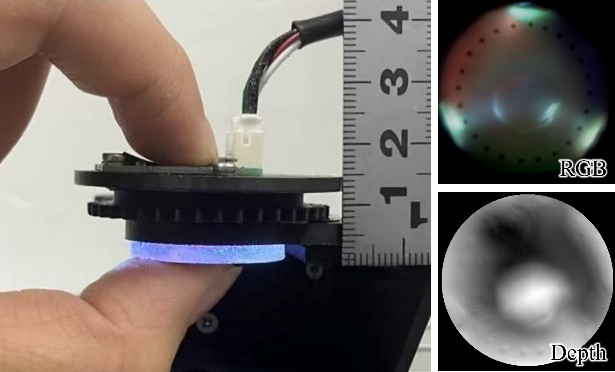
Wider touch, in a thin fingertip
A rotating pinhole module scans across the contact surface. Calibrated image stitching expands tactile coverage while keeping the sensing module thin.
10 to 28 mm effective field-of-view width
Explore the projectOpen to industry R&D opportunities in Japan
Yuan Gao, PhD
I develop compact tactile sensors and 3D perception algorithms, connecting optical design with hardware prototyping and experimental validation.
Algorithm Engineer · PhD, The University of Osaka
Selected research / 2023–2026
A rotating pinhole module scans across the contact surface. Calibrated image stitching expands tactile coverage while keeping the sensing module thin.
10 to 28 mm effective field-of-view width
Explore the project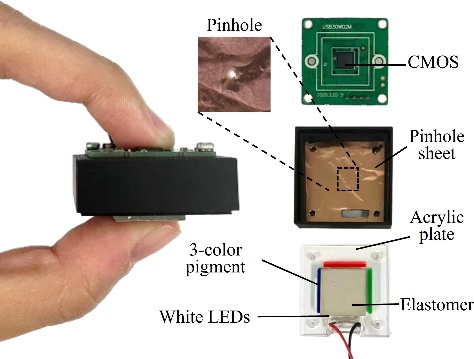
Pinhole imaging removes the bulky lens assembly. An optical model guides the trade-off between sensor thickness, field of view, and image quality.
34 to 15 mm thickness versus a matched lens design
Explore the project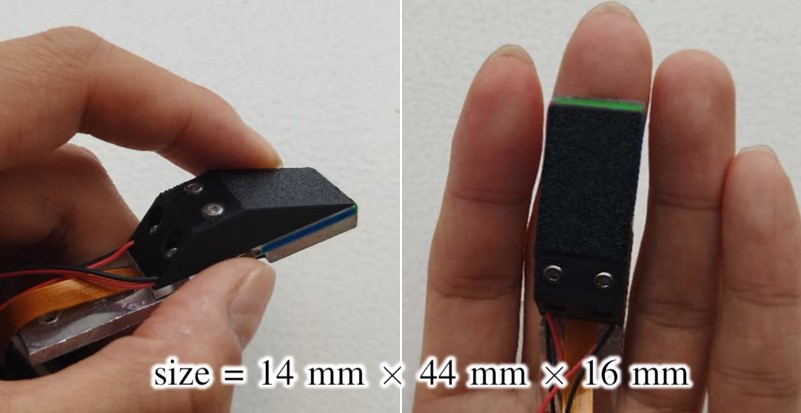
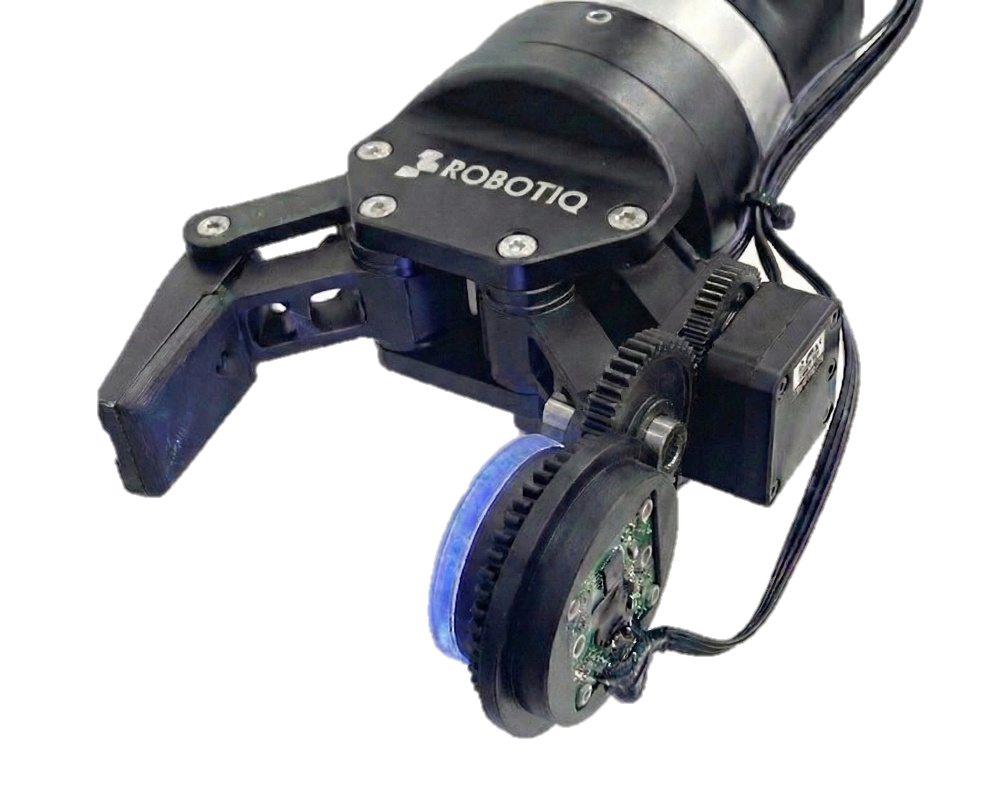
Folded optics and fluorescent coatings make high-resolution contact sensing small enough to fit on a parallel robot gripper.
Approximately 14 mm thick; materials under US$20
Explore the project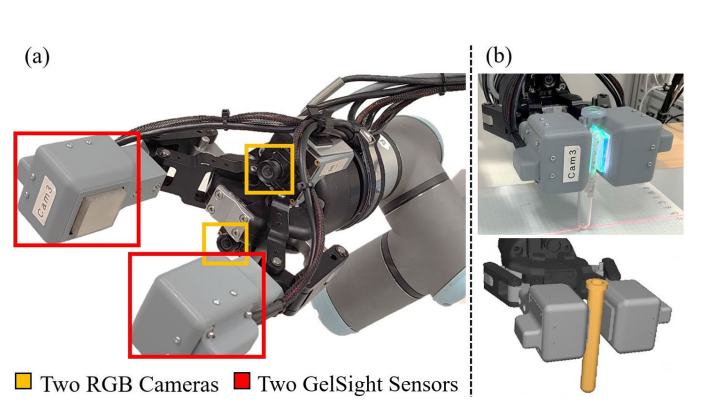
Palm cameras and fingertip tactile sensors provide complementary observations of grasped objects, including transparent and reflective surfaces.
6D pose estimation and real-robot insertion experiments
Explore the projectEngineering approach
My doctoral work covered the full sensor development cycle, from defining the problem to evaluating prototypes on real hardware.
Experience & technical skillsBackground
I completed my PhD in Engineering at The University of Osaka in March 2026, following a master's degree there and a bachelor's degree in Physics at Zhejiang University.
I am now an Algorithm Engineer at Shanghai Aerospace Control Technology Institute in China, developing 3D point-cloud pose-estimation algorithms. I am interested in industry research and engineering roles in Japan where I can contribute to optical sensing, robotic perception and sensor development.
Working across languages
Chinese (native), Japanese (JLPT N2, 2019), and English (TOEFL iBT 96, 2017). More than seven years of study and research in Japan.
Opportunities in Japan
I welcome conversations with industry teams working on robotics, optical sensing, computer vision and intelligent hardware.
日本の企業で、光学センシング・ロボット知覚・センサ開発に関わる研究開発職を希望しています。