2026 / Optical design · Calibration · Reconstruction
Wider tactile coverage through rotational scanning
A rotating pinhole imaging module expands the contact area a thin tactile sensor can observe. Calibration and image stitching combine multiple views into a larger depth map.
The engineering problem
Making a tactile sensor thinner restricts how much of its contact surface a camera can see at once. The preceding static pinhole prototype achieved a thin package, but its field of view limited tactile coverage.
What I developed
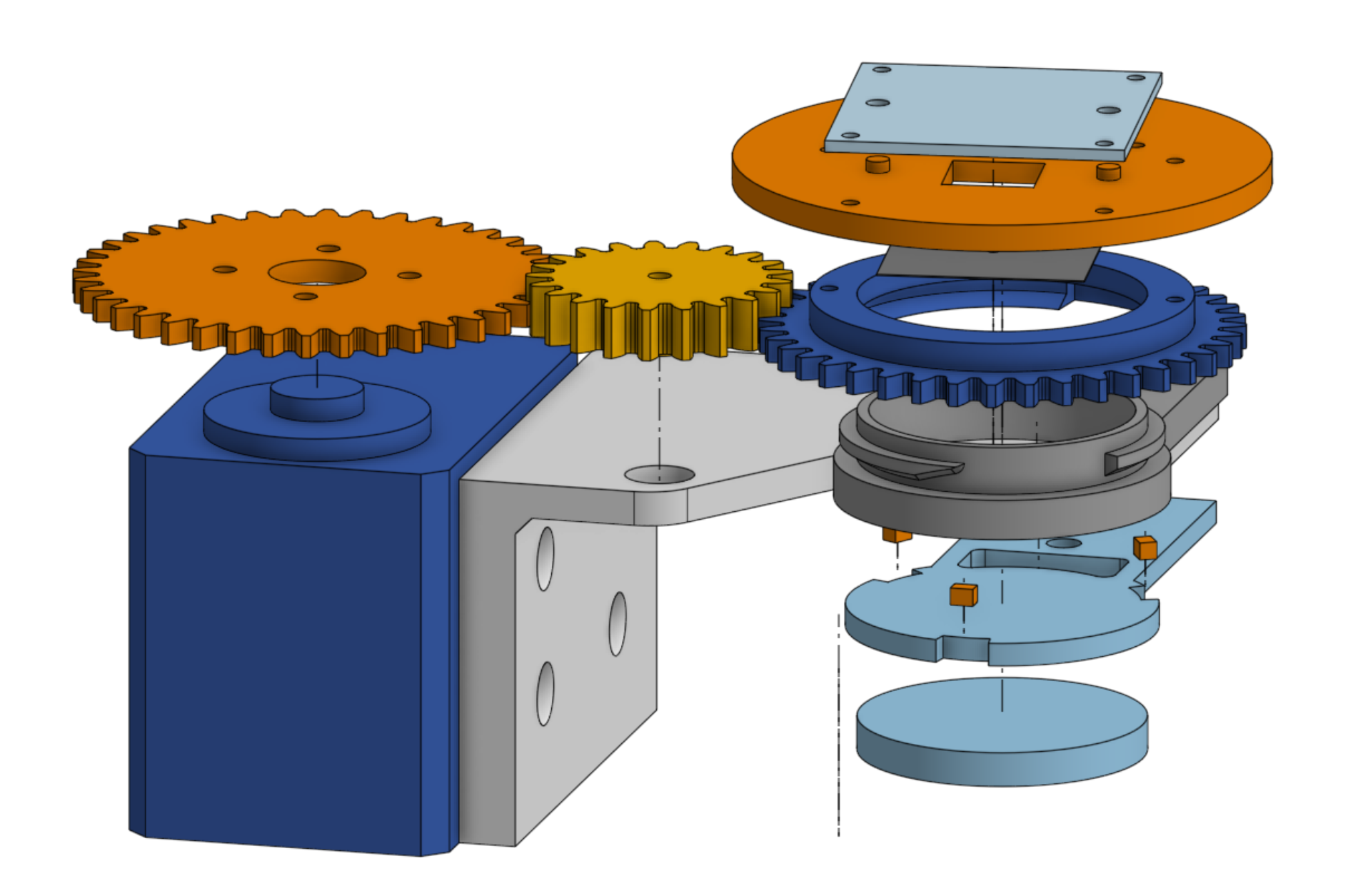
I designed a thin geared mechanism that rotates the pinhole module, driven by a rear-mounted Dynamixel motor. The module captures overlapping views of the contact surface without increasing fingertip thickness.
To align those views, I estimated the rotation center using marker tracking, least squares and RANSAC. Center-weighted blending combines the registered images for photometric depth reconstruction. My work covered the optical and mechanical design, prototype fabrication, calibration, experiments and paper writing.
Effective field-of-view width: 10 to 28 mm. The sensing part is 14.34 mm thick, and the stitched image contains approximately 560 × 560 pixels.
Results and trade-offs
The expanded field of view supports reconstruction over a larger contact region. The sensor was also integrated with a robot gripper to demonstrate the hardware configuration.
The reported full scan took 262 seconds at 4 frames per second. Depth reconstruction took a separate 0.28 seconds on the evaluation computer. This prototype demonstrates wider coverage for static contacts; its scanning time remains a constraint for dynamic manipulation. Boundary depth underestimation also revealed the effect of objects blocking illumination in the light guide.
Why it matters
This project connects optical modeling with mechanism design and calibration. It shows how an imaging constraint can be addressed through controlled motion, while making the acquisition-time trade-off explicit.
The final paper is “A Thin Pinhole-Based Tactile Sensor With Rotational Scanning for Field-of-View Expansion,” IEEE Sensors Journal, 26(8), 11778–11787, 2026.