
Rotational scanning for a wider field of view
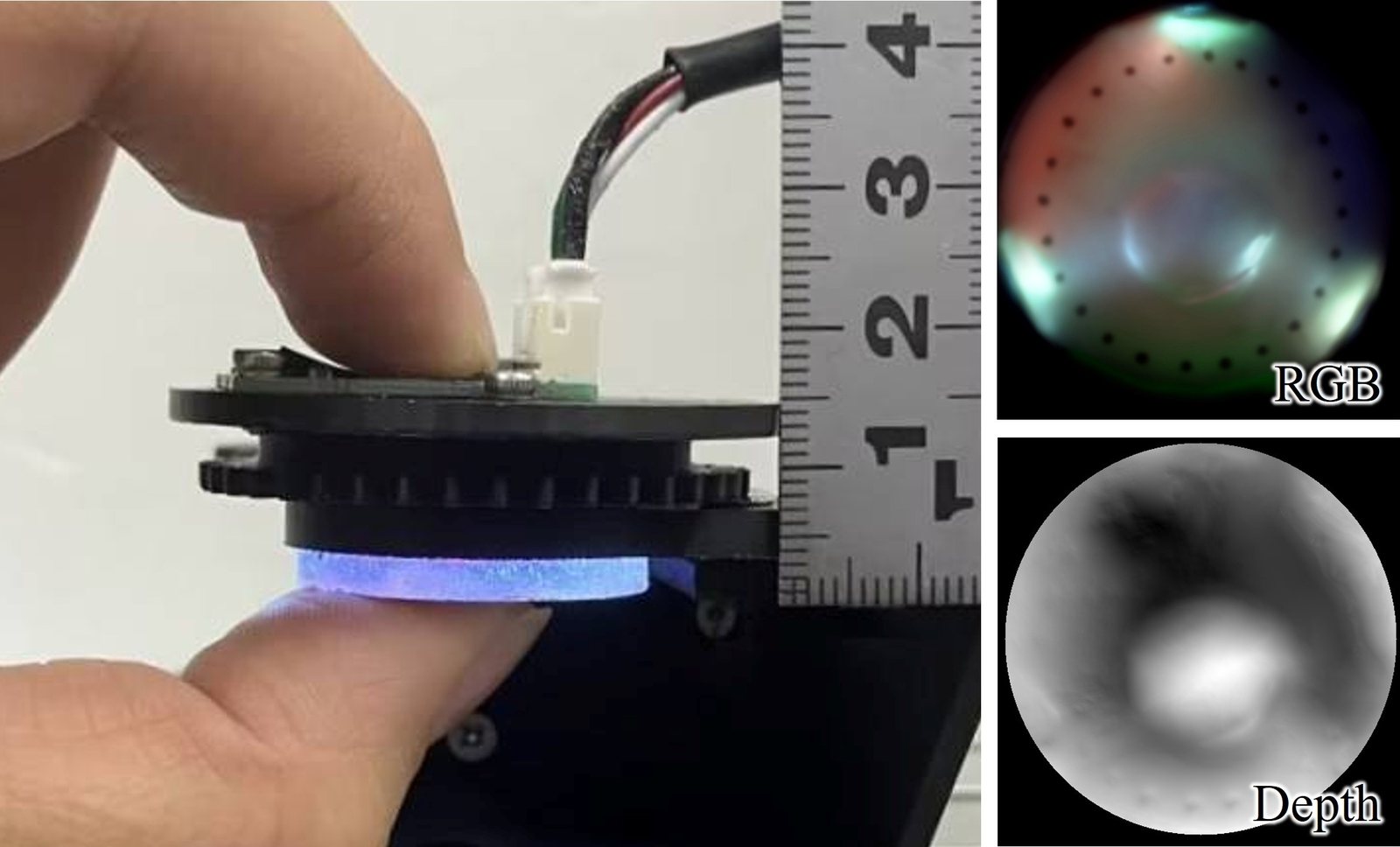
Problem. A pinhole camera placed close to the elastomer keeps a tactile sensor thin, but it sees only a small patch of the contact surface. My previous static pinhole prototype covered a width of 10 mm.
Approach. I designed a thin geared mechanism that rotates the pinhole module, driven by a Dynamixel motor mounted behind the fingertip. The rotation center is estimated from tracked markers with least squares and RANSAC, and the registered frames are blended with center weighting into a single 28 × 28 mm depth map.
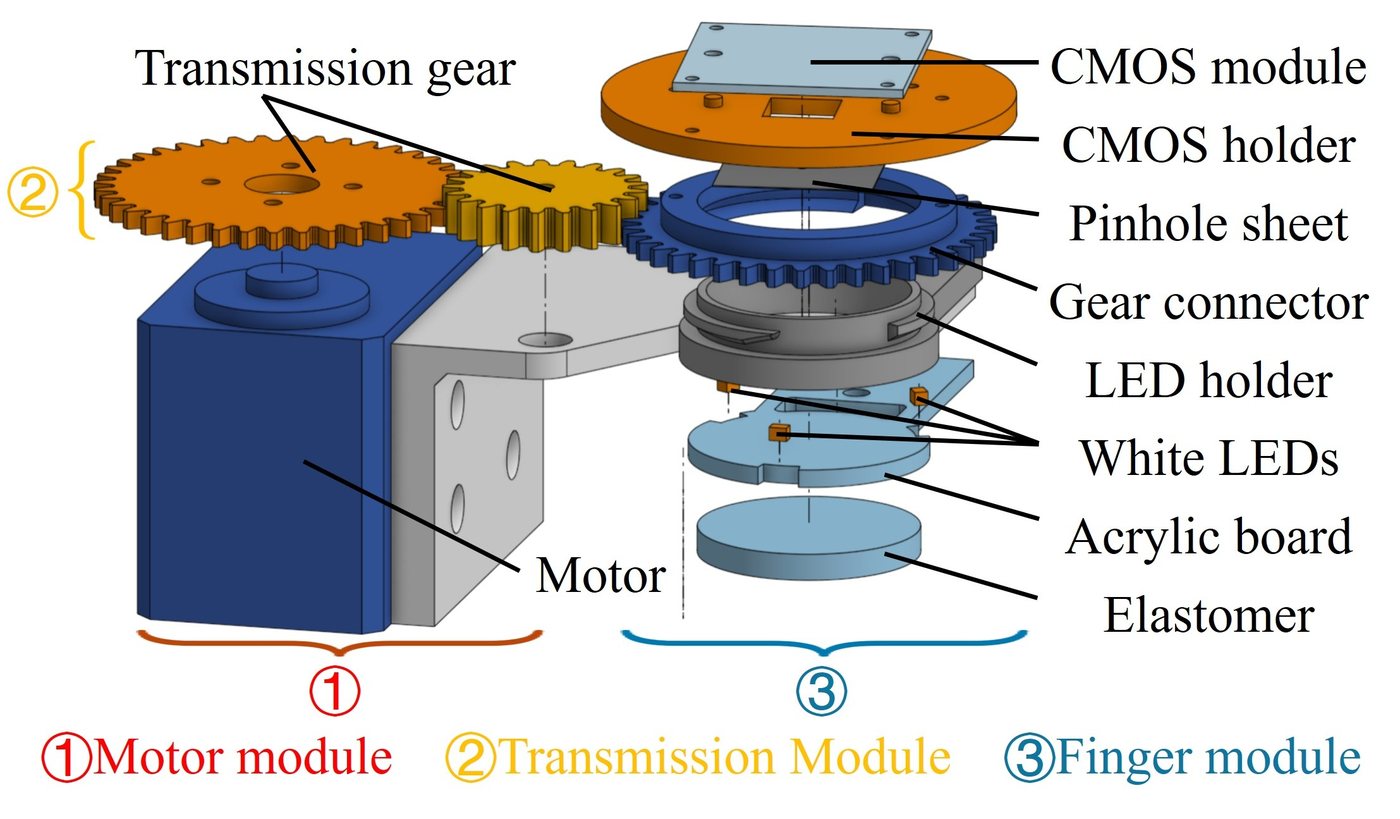
Result. The effective field-of-view width grew from 10 mm to 28 mm, and the sensing part ended up slightly thinner than the static prototype (15.0 → 14.3 mm). The evaluation also traced a systematic depth underestimation at object boundaries to the object blocking light inside the light guide.
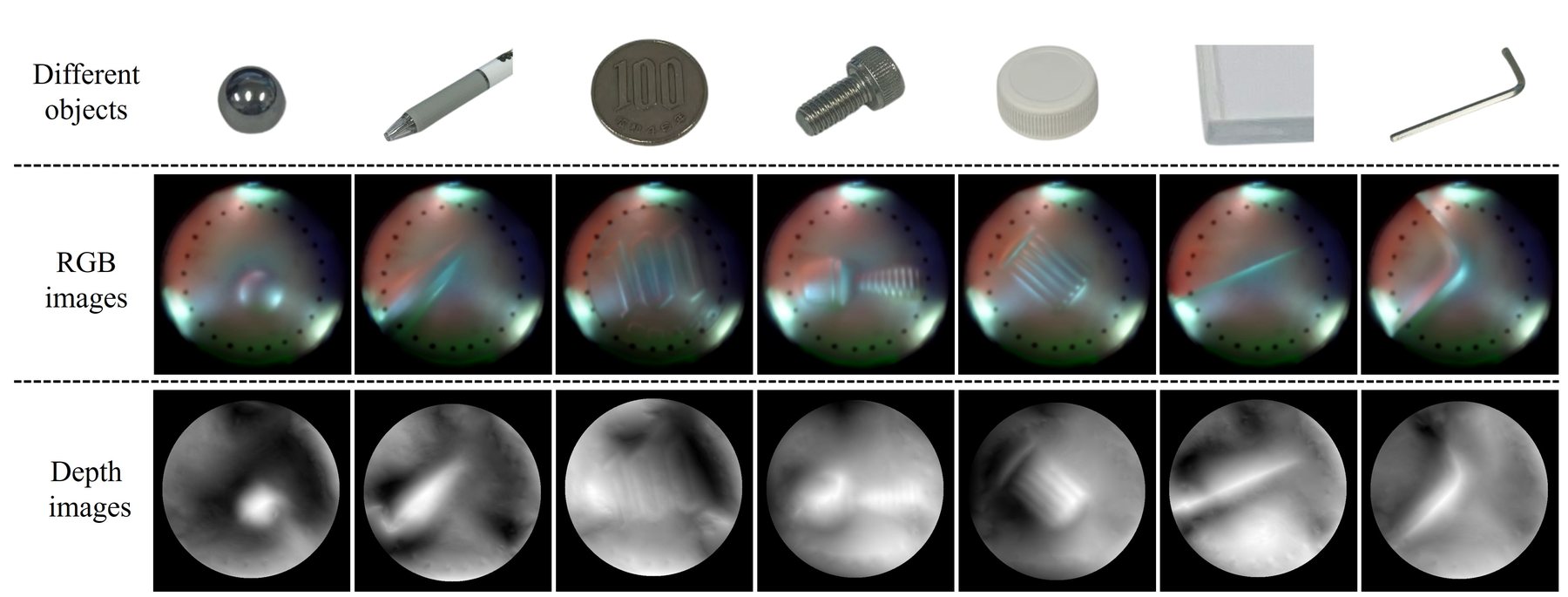
My role. Lead researcher and first author: mechanism and optical design, prototyping, calibration, reconstruction, evaluation and writing.
Paper. Y. Gao, S. Zhang, W. Wan, B. Fang, F. Sun and K. Harada, “A Thin Pinhole-Based Tactile Sensor With Rotational Scanning for Field-of-View Expansion,” IEEE Sensors Journal, vol. 26, no. 8, 2026. doi:10.1109/JSEN.2026.3668906